


The rapid acceleration
of artificial intelligence has created a new category of computing
hardware—machines that are neither traditional workstations nor full-scale data
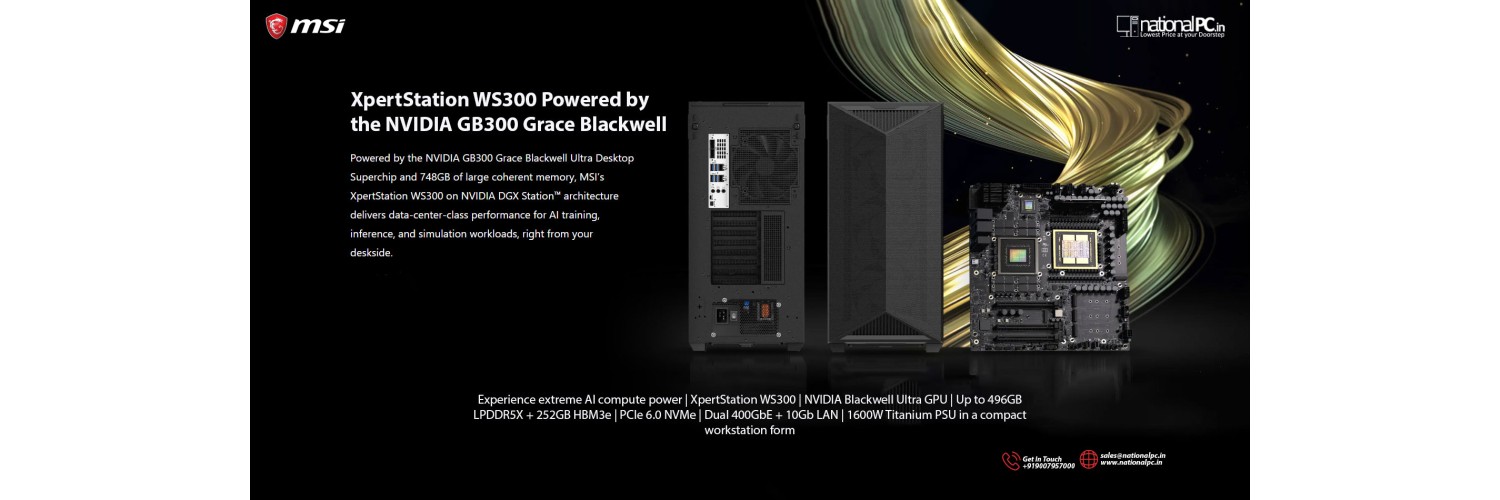
center servers, but something in between. The MSI XpertStation WS300,
powered by the NVIDIA GB300 Grace Blackwell Ultra Desktop Superchip,
represents one of the most ambitious attempts yet to bring data center–grade
AI performance into a deskside form factor.
This is not just
another high-end workstation. It is a purpose-built AI system designed for large
language models (LLMs), generative AI, scientific simulations, and enterprise
data science workloads. With up to 20 petaFLOPS of AI compute, 748GB
of unified memory, and dual 400GbE networking, the WS300 redefines
what “desktop computing” can mean in 2026.
In this in-depth
4000-word expert review, we’ll explore every aspect of the WS300—from
architecture and performance to real-world usability, benchmarks, and buying
considerations—so you can determine whether this AI powerhouse is the right
investment for your organization.
⭐ Expert Verdict
Rating: 9.2 / 10
Best For:
Enterprise AI teams, research labs, LLM development, private AI infrastructure,
simulation-heavy industries
Not For:
General users, gamers, standard content creators, or budget-conscious buyers
 Key Highlights
- NVIDIA GB300 Grace Blackwell Ultra Desktop
Superchip
- Up to 20 PFLOPS AI performance
- 748GB coherent unified memory (HBM3e + LPDDR5X)
- Dual 400GbE ultra-fast networking
- PCIe Gen5 & Gen6 storage and expansion
- Desk-side AI supercomputer form factor
- Enterprise-grade reliability and scalability
Understanding the WS300: A New Class of
Workstation
To understand the MSI
XpertStation WS300, you must first abandon the traditional idea of a
workstation.
Most workstations are
built around:
- A CPU (Intel Xeon / AMD Threadripper)
- One or more GPUs connected via PCIe
- Separate system memory (RAM) and GPU
memory (VRAM)
The WS300 is
fundamentally different.
It uses the NVIDIA
Grace Blackwell architecture, where:
- CPU and GPU are tightly integrated
- Memory is unified and coherent
- Data movement bottlenecks are drastically
reduced
This architecture is
designed specifically for AI workloads, where data movement—not raw
compute—is often the biggest limitation.
⚙️ Architecture Deep Dive
NVIDIA GB300 Grace
Blackwell Ultra Superchip
At the heart of the
WS300 lies the GB300 superchip, combining:
- Grace CPU (ARM-based, high-bandwidth,
energy-efficient)
- Blackwell Ultra GPU (next-gen AI accelerator)
These are connected
via NVLink-C2C, which delivers: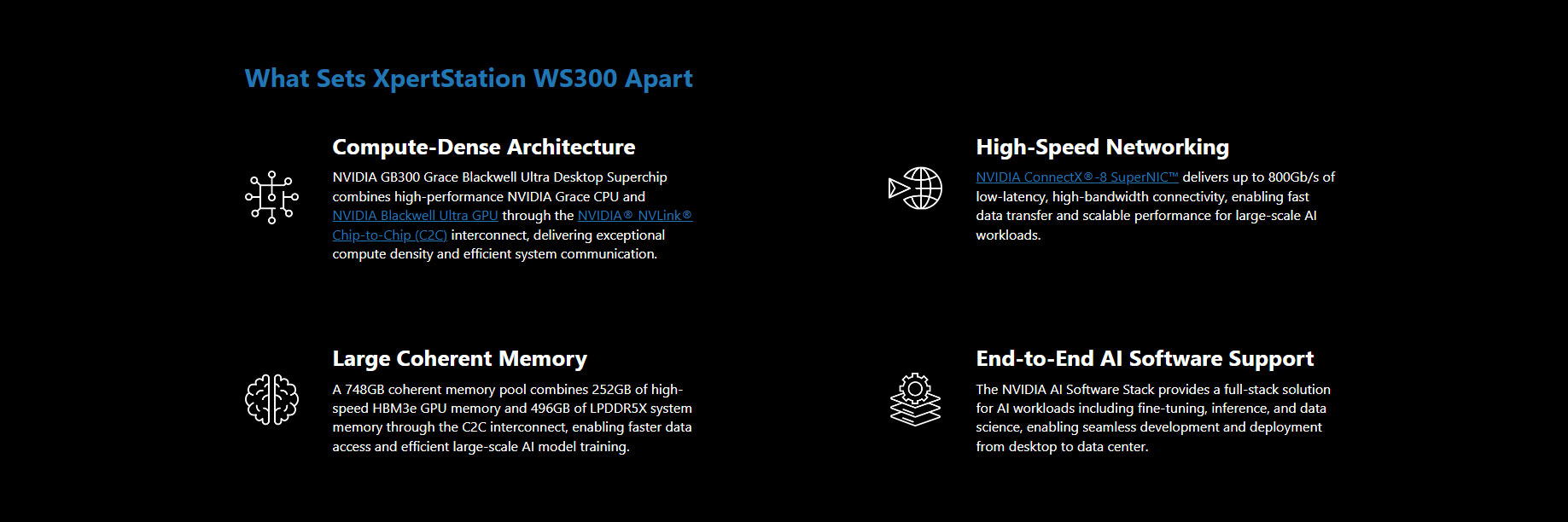
- Ultra-low latency
- Massive bandwidth between CPU and GPU
- Shared memory access
This eliminates the
traditional bottleneck of PCIe communication.
Unified Coherent Memory (748GB)
One of the most
revolutionary aspects of the WS300 is its memory system:
- 252GB HBM3e GPU memory
- 496GB LPDDR5X CPU memory
- Combined into a 748GB unified coherent
pool
Why this matters:
In traditional
systems:
- CPU and GPU have separate memory
- Data must be copied back and forth
In WS300:
- CPU and GPU access the same memory space
- No duplication
- No bottlenecks
Real-world impact:
- Train larger models without memory
fragmentation
- Faster inference pipelines
- Reduced latency in data-heavy workflows
Enterprise Networking: Dual 400GbE
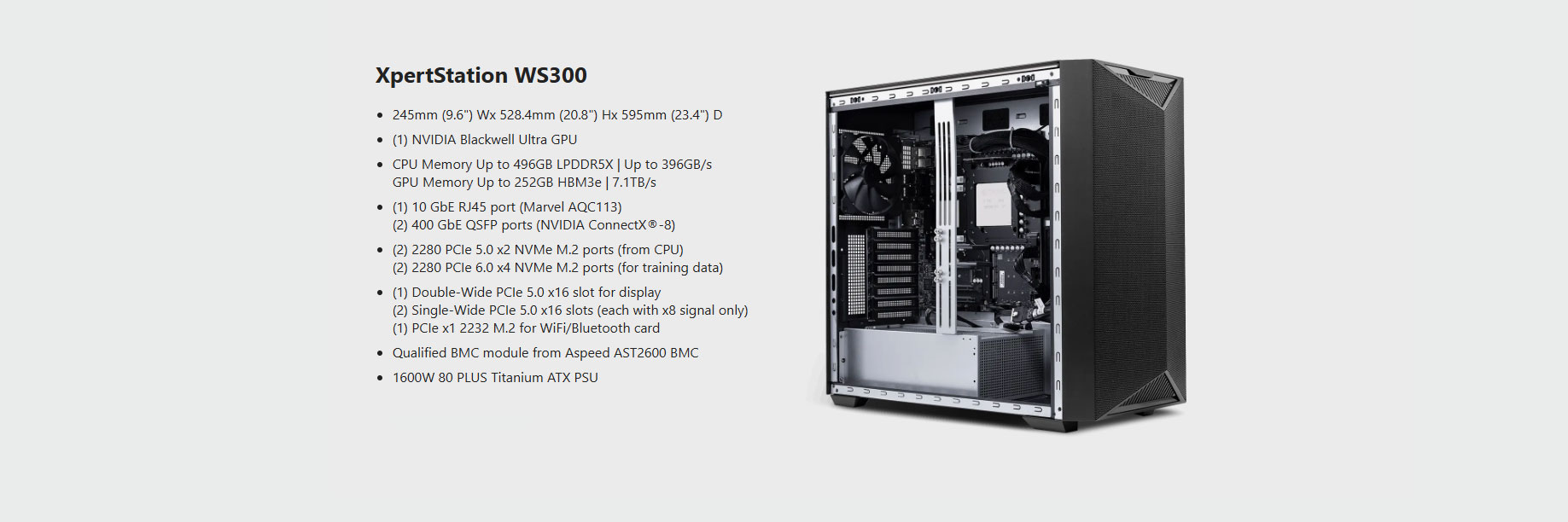
The WS300 includes:
- 2× 400GbE QSFP ports
- 1× 10GbE RJ45
This allows:
- Ultra-fast data transfer
- Cluster connectivity
- Distributed AI workloads
You can connect
multiple WS300 systems together to scale performance—effectively building a
mini AI cluster.
Benchmark & Performance Positioning
Since independent
third-party benchmarks are still emerging, we rely on spec-based and vendor
positioning benchmarks.
AI Performance
Comparison
|
System |
AI Compute |
Memory |
Target Workload |
|
Edge AI Box |
~1 PFLOP |
128GB |
Edge inference |
|
AI Workstation (RTX
6000 Ada) |
~2–4 PFLOPS |
48–96GB |
Mid-scale AI |
|
MSI WS300 |
Up to 20 PFLOPS |
748GB |
Large-scale AI |
|
Data Center Node |
20–100+ PFLOPS |
1TB+ |
Hyperscale AI |
Expected
Performance Gains
Compared to
RTX-based workstations:
- 5–10× faster large-model inference
- Massively higher memory capacity
- Reduced data transfer overhead
Compared to cloud
instances:
- Lower latency
- No recurring compute cost
- Full data privacy
Real-World Use Cases
1. Large Language
Model (LLM) Development
- Fine-tune models like GPT-style
architectures
- Run local inference for enterprise
applications
- Test multi-billion parameter models
2. Generative AI
- Image generation pipelines
- Video AI workflows
- Multimodal AI systems
3. Scientific
Computing
- Climate simulations
- Molecular modeling
- Physics-based simulations
4. Enterprise Data
Science
- Large dataset processing
- Predictive analytics
- AI-driven automation
Design & Build Quality
The WS300 is built
like a premium enterprise workstation, not a flashy gaming PC.
Key
characteristics:
- Large, industrial-grade chassis
- Optimized airflow for high thermal loads
- Quiet operation relative to performance
- Serviceable components for enterprise IT
teams
Connectivity & Expansion
- PCIe Gen5 slots for expansion
- PCIe Gen6 NVMe storage support
- Multiple NVMe drives for high-speed
storage
- Support for additional GPUs (depending on
configuration)
This ensures the WS300
remains future-proof for years.
⚡ Power & Cooling
- 1600W 80+ Titanium PSU
- Advanced cooling system
- Designed for continuous 24/7 operation
Despite its power, it
is optimized for efficiency compared to traditional GPU clusters.
Security & On-Prem AI Advantage
One of the biggest
reasons to buy the WS300 is data sovereignty.
Benefits:
- Keep sensitive data local
- Avoid cloud dependency
- Reduce compliance risks
- Maintain full control over AI pipelines
Price & Value Analysis
Approx price:
~₹12980000
This may seem
extreme—but consider:
- Comparable cloud infrastructure costs over
time
- Data transfer costs
- Subscription-based AI compute
ROI Perspective:
For organizations
running heavy AI workloads, the WS300 can:
- Pay for itself in 1–2 years
- Reduce cloud dependency
- Increase development speed
Q&A Section
Q1: Is WS300 better
than RTX 6000 Ada workstations?
Yes—for AI workloads.
It offers significantly higher memory and compute.
Q2: Can it replace
a data center?
Partially. It can
handle many workloads locally but not hyperscale operations.
Q3: Is it suitable
for video editing?
No. It is optimized
for AI, not media workflows.
Q4: How many users
can share it?
Multiple users can
access via network or virtualization.
Q5: Does it support
clustering?
Yes, via 400GbE
networking.
Q6: Is it
future-proof?
Highly—thanks to PCIe
Gen6 and Blackwell architecture.
Q7: What industries
benefit most?
AI startups, research
labs, healthcare, finance, defense, and tech enterprises.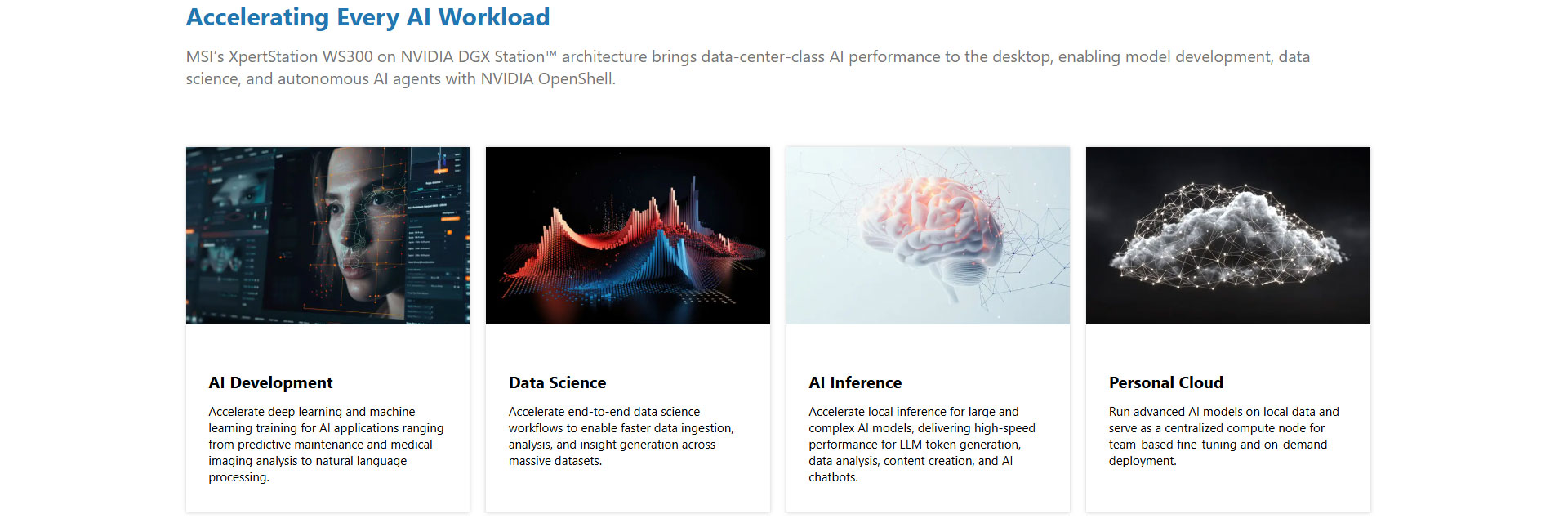
Where to Buy
Buy from NationalPC (Authorized Seller):
https://nationalpc.in/tower-pc/msi-xpertstation-nvidia-gb300-ws300t60l-grace-blackwell-ultra-desktop-superchip
Official MSI Information:
https://www.msi.com/Landing/NVIDIA-DGX-STATION
Final Verdict
The MSI
XpertStation WS300 is not just a workstation—it is a statement about the
future of computing.
As AI workloads grow
larger and more complex, traditional systems struggle to keep up. The WS300
bridges the gap between desktop and data center, offering:
- Massive compute power
- Unified memory architecture
- Enterprise-grade networking
- Local AI sovereignty
For organizations
serious about AI, this is one of the most powerful tools available today.
For everyone else—it’s
a fascinating glimpse into the future.
Leave a comment