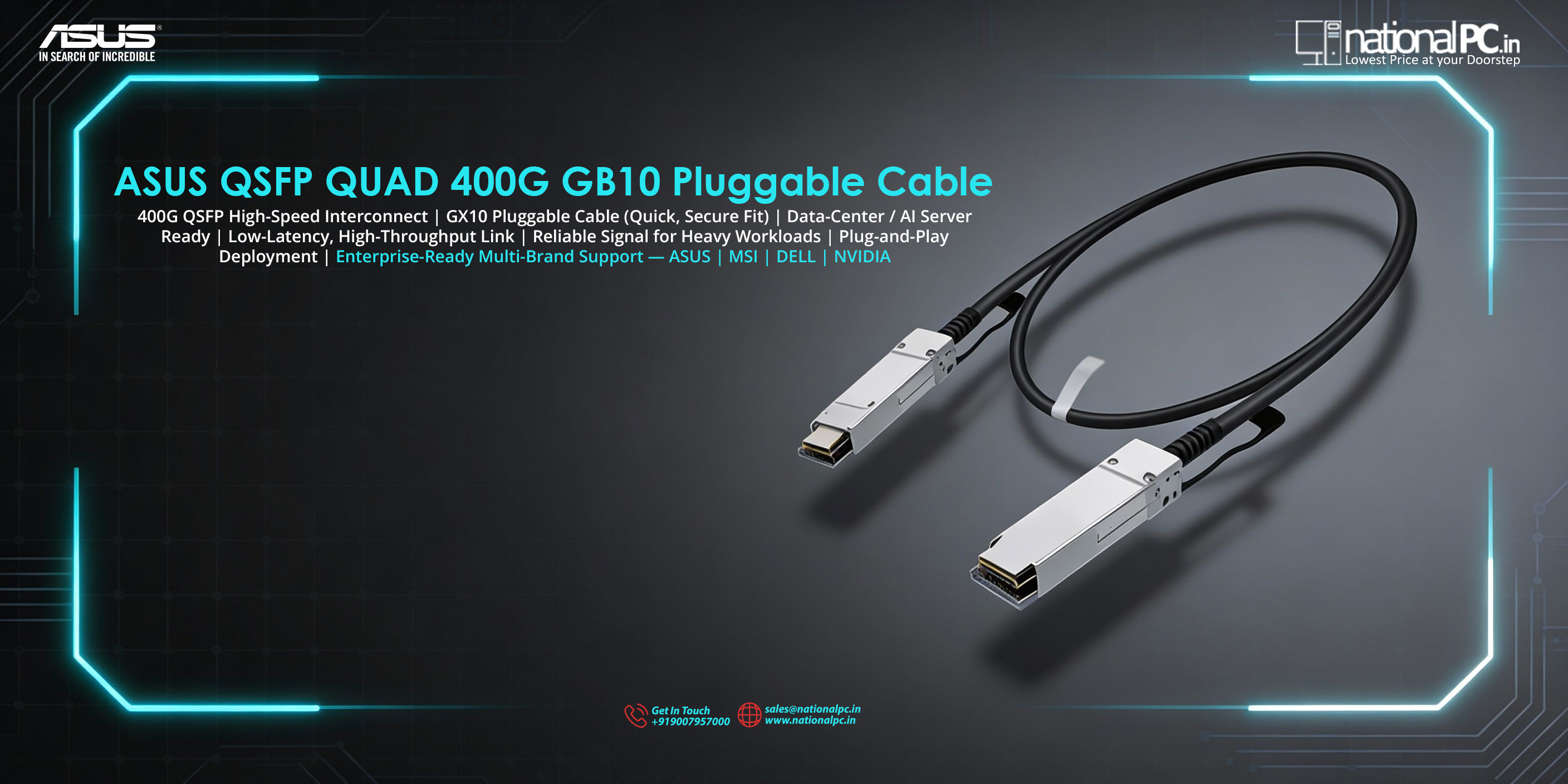
ASUS QSFP QUAD 400G GX10 Pluggable Cable (0.4m): Reliable High-Bandwidth Links for AI & Data Center Labs
Quick Review Verdict
The ASUS QSFP QUAD 400G GX10 cable is a purpose-built QSFP112 Cable for short, high-bandwidth AI and HPC interconnects. Its clearest use case is ASUS GX10 system stacking. Buyers searching for a DGX Cable or GB10 Cable should confirm the exact port, platform and firmware support before ordering. The 0.4m format is ideal for adjacent systems where a compact 400Gbps cable is required.
Table of Contents
What Is the ASUS QSFP QUAD 400G GX10 Pluggable Cable?
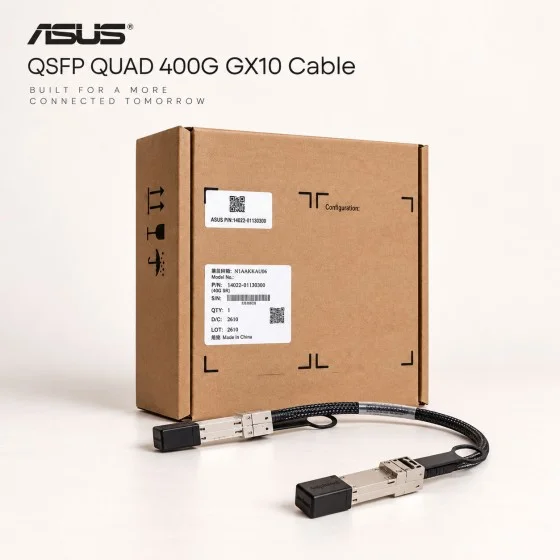
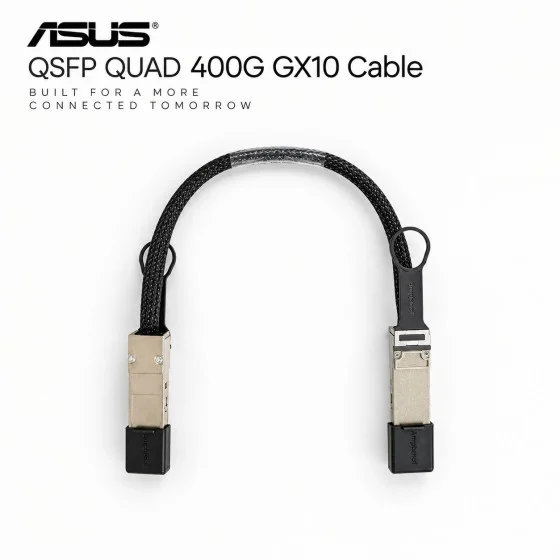
The ASUS QSFP QUAD 400G GX10 Pluggable Cable is a short 0.4m direct interconnect designed for supported AI systems, supercomputer stacking and high-bandwidth data-center links. ASUS identifies the accessory as a QSFP112 400G 0.4M DAC cable with 112G-per-lane signaling, PAM-4 operation and up to 400G aggregate bandwidth.
In search terms, buyers may call this a GX10 Cable, DGX Cable, GB10 Cable, QSFP112 Cable or 400Gbps cable. Those phrases overlap, but compatibility is determined by the actual interface and platform support rather than the search term alone.
ASUS QSFP112 Cable: Key Specifications
| Specification | ASUS GX10 Cable | Practical Meaning |
|---|---|---|
| Model | QSFP112 400G 0.4M DAC cable | Purpose-built short high-speed interconnect |
| Connector | QSFP112 | Both endpoints must support the required link mode |
| Bandwidth | Up to 400G aggregate | High-bandwidth AI/HPC communication |
| Per-Lane Rate | 112G class per lane | Modern PAM-4 high-speed signaling |
| Length | 0.4m / 400mm | Best for adjacent or stacked systems |
| Weight | 95g | Compact direct-attach form factor |
GX10 Cable for ASUS Ascent GX10 Stacking
The strongest and most direct use case is ASUS Ascent GX10. The short GX10 Cable is designed for nearby high-bandwidth system links where large AI datasets, checkpoints or distributed workloads may need to move rapidly between systems.
The 0.4m length makes sense on a lab bench, inside a compact rack or anywhere two supported systems sit directly beside one another.
Buy GX10 Cable from NationalPC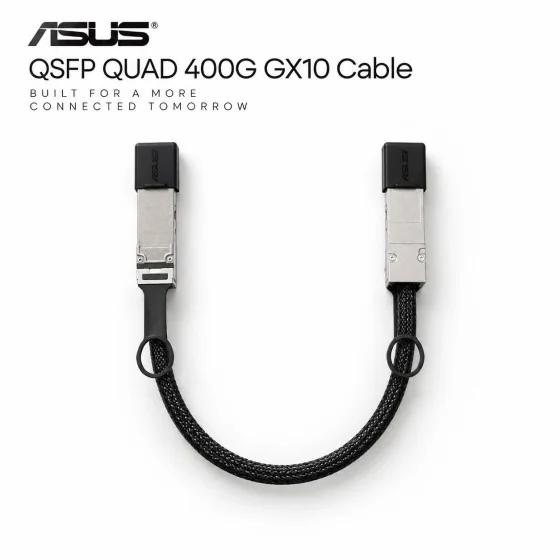
DGX Cable and GB10 Cable Compatibility: What to Check First
NationalPC lists this cable as compatible with ASUS GX10 1TB, 2TB and 4TB models and also lists compatible MSI EdgeXpert, NVIDIA DGX and Dell Pro Max GB10 systems. Even so, buyers should verify the exact endpoint model, QSFP112 400G support and firmware requirements before purchase.
QSFP112 Cable vs QSFP56 / QSFP-DD
This ASUS product is specifically identified as a QSFP112 Cable. Connector families can appear similar, but bandwidth class, lane signaling and device support are different. Do not buy by physical shape alone.
| Interface | Typical Class | Buyer Note |
|---|---|---|
| QSFP56 | 200G class | Not the same interface class as this product. |
| QSFP112 | 400G class | This is the documented ASUS GX10 cable interface. |
| QSFP-DD | 400G / 800G ecosystem | Verify endpoint support; do not assume interoperability. |
400Gbps Cable Performance: What the Link Actually Delivers
A 400Gbps cable does not create extra compute performance by itself. It enables compatible systems to communicate over a high-speed physical link. That matters when AI workloads continuously move tensors, model data, checkpoints or large datasets between systems.
400G Link Class
Designed for up to 400G aggregate connectivity on supported hardware.
0.4m Short Path
Optimized for adjacent systems and compact AI lab installations.
Direct-Attach Simplicity
Avoids separate optical modules for a very short system-to-system run.
ASUS QSFP QUAD 400G GX10 Cable Benchmark
A high-speed cable should not be benchmarked like a CPU, GPU or SSD. The most useful measurements are supported link bandwidth, endpoint stability, error rate, installation fit and sustained communication under AI/HPC traffic. The figures below separate hard specifications from practical review scoring.
| Benchmark | Result / Rating | What It Means |
|---|---|---|
| Rated Link Bandwidth | 400 Gbps | Maximum supported link class on compatible endpoints |
| Theoretical Byte Rate | 50 GB/s | 400 Gbps ÷ 8 before protocol and application overhead |
| Per-Lane Signaling | 112G class | QSFP112 high-speed lane architecture |
| Cable Length | 0.4m | Excellent for adjacent or stacked systems |
Installation, Hot-Plugging and Downtime
The NationalPC product page describes the cable as hot-pluggable for convenient installation and replacement. That describes the physical interface; it does not guarantee uninterrupted service when a live link is removed. A single point-to-point interconnect will still be interrupted if the cable is disconnected.
Who Should Buy This GX10 / DGX / GB10 Cable?
Buy It If
- You are linking supported ASUS GX10 systems.
- You need a short 0.4m QSFP112 400G connection.
- You want a platform-focused OEM cable.
- Your AI lab places systems directly beside each other.
Double-Check First If
- You are buying it specifically as a DGX Cable.
- Your GB10 system is from a different manufacturer.
- Your endpoint documentation specifies QSFP56 or QSFP-DD.
- You need a longer cable or breakout topology.
ASUS QSFP QUAD 400G GX10 Cable Images
FAQ: DGX Cable, GX10 Cable, GB10 Cable and QSFP112 400G
Is this an ASUS GX10 Cable?
Yes. ASUS documents it as a QSFP112 400G 0.4m cable in the GX10 ecosystem, and NationalPC lists it for GX10 system stacking.
Can I use it as a DGX Cable?
NationalPC lists compatible NVIDIA DGX systems, but the exact DGX model should still be checked for QSFP112 400G support before ordering.
Is this a GB10 Cable?
It can be relevant to compatible GB10-class systems. NationalPC lists Dell Pro Max GB10 compatibility, but GB10 alone does not guarantee one universal cable interface.
What is a QSFP112 Cable?
QSFP112 is a high-speed pluggable interface class using four high-speed lanes. This ASUS cable is designed for 400G-class aggregate connectivity.
Is this a 400Gbps cable?
It is designed for up to 400G aggregate QSFP112 connectivity on compatible hardware. Real application throughput depends on both endpoints and the software stack.
Verdict: A Strong 0.4m QSFP112 400G Cable for the Right AI System
For ASUS Ascent GX10 stacking, this cable has a clear role. Buyers searching for a DGX Cable, GB10 Cable, QSFP112 Cable or 400Gbps cable should make exact compatibility the deciding factor. Match the port, platform and cable length first, then use the verified NationalPC product page below.